From Bubbles to Full Utilization: A practicle Guide to pipeline Scheduling in Distributed Deep…
From Bubbles to Full Utilization: A practicle Guide to pipeline Scheduling in Distributed Deep Learning Introduction As deep learning models scale to billions of parameters, the bo…
From Bubbles to Full Utilization: A practicle Guide to pipeline Scheduling in Distributed Deep Learning
Introduction
As deep learning models scale to billions of parameters, the bottleneck is no longer just model design, it is system efficiency. Many practitioners invest in multiple GPUs expecting linear speedups, only to find that their hardware remains underutilized.
The reason often lies in how computation is scheduled across devices. In pipeline parallelism, inefficient scheduling introduces idle time, commonly referred to as pipeline bubbles, which can significantly degrade performance.
This article explores the evolution of pipeline scheduling strategies, from naive execution to advanced techniques such as 1F1B, Interleaved 1F1B, and Zero Bubble scheduling. More importantly, it explains when each method is appropriate in real-world systems.
Understanding Pipeline Bubbles
In pipeline parallelism, a model is divided across multiple GPUs, and micro-batches flow sequentially through these stages. While this allows models to scale beyond a single device, it introduces inefficiencies.
At the beginning of training, only the first GPU is active while others wait. Similarly, at the end, some GPUs finish early and remain idle while others complete their work. These idle periods are known as pipeline bubbles.
Even in well-designed systems, bubbles are unavoidable, but their impact can be reduced through better scheduling.
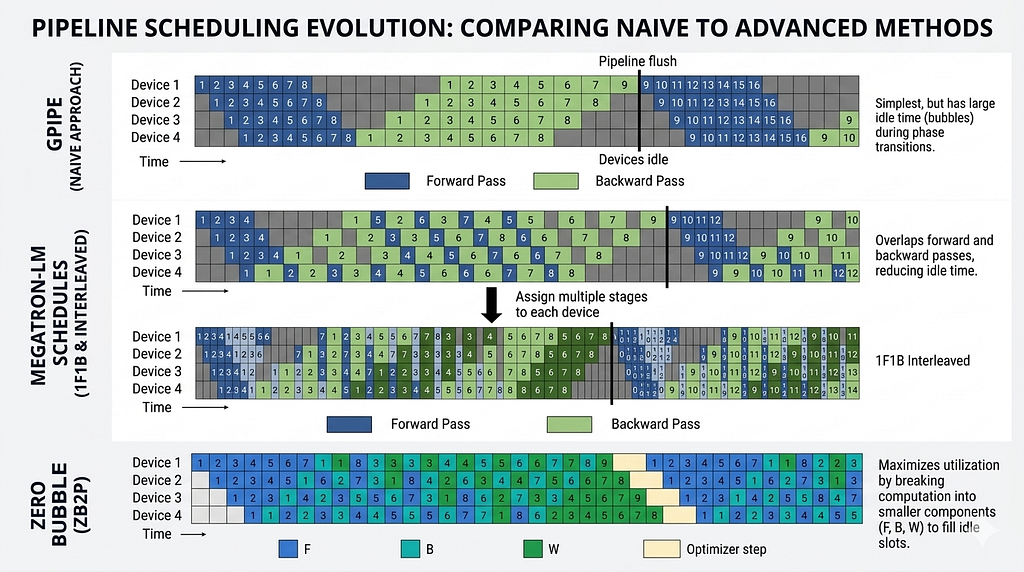
GPipe: The Naive Approach
The simplest scheduling strategy is often referred to as GPipe.
In this approach, all forward passes are executed first, followed by all backward passes. While conceptually straightforward, this method suffers from two major drawbacks: high memory usage and poor GPU utilization.
Because backward computation starts only after all forward passes are completed, GPUs spend significant time idle during phase transitions. Additionally, all intermediate activations must be stored, increasing memory pressure.
GPipe is useful for understanding pipeline behavior, but it is rarely suitable for production-scale systems.
1F1B: One Forward, One Backward
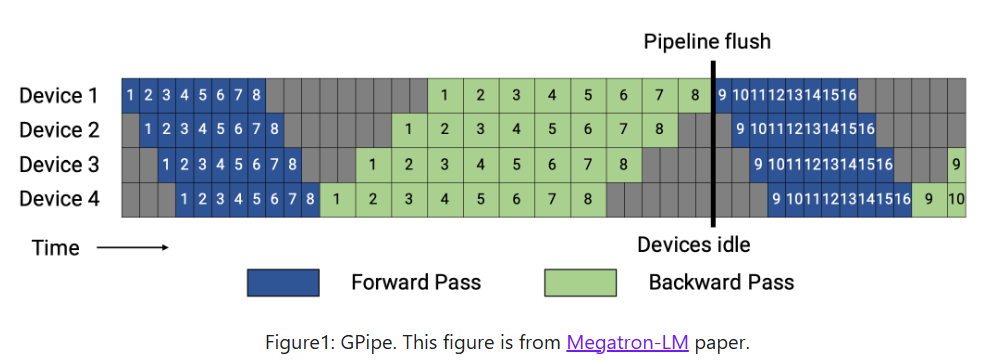
The 1F1B scheduling strategy addresses the inefficiencies of GPipe by overlapping forward and backward computation.
Once the pipeline is filled, each GPU alternates between processing a forward pass for a new micro-batch and a backward pass for an earlier one. This overlap significantly improves GPU utilization and reduces memory requirements, as activations can be freed earlier.
Although small bubbles still exist during the warm-up and flush phases, 1F1B provides a strong balance between performance and implementation complexity.
In practice, 1F1B has become the default choice for many production systems.

Interleaved 1F1B: Increasing Pipeline Granularity
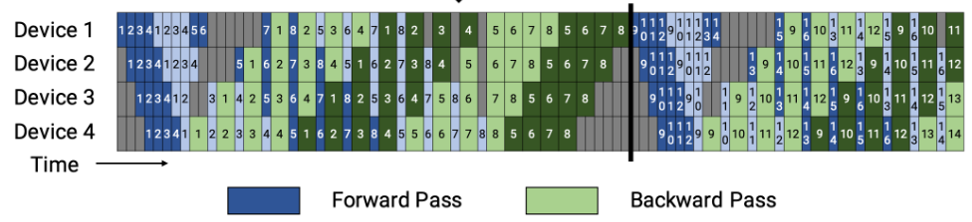
While 1F1B improves utilization, it still operates on relatively large pipeline stages. Interleaved 1F1B introduces a more refined approach by dividing each GPU into multiple smaller virtual stages.
Instead of assigning one contiguous block of layers to each GPU, the model is split into finer-grained chunks distributed across devices. This effectively increases the number of pipeline stages without increasing the number of GPUs.
With smaller stages, computation can be scheduled more flexibly, reducing idle time and improving overall throughput.
However, this comes at the cost of increased communication and greater implementation complexity.
Zero Bubble Scheduling: Eliminating Idle Time
Zero Bubble scheduling takes optimization a step further by targeting the root cause of idle periods.
The key idea is to break the backward pass into smaller components, such as activation gradient computation and weight gradient computation. By doing so, the scheduler gains more flexibility in assigning work and can fill previously idle slots.
As a result, GPUs remain active for nearly the entire training process, leading to significantly improved utilization.
This approach is highly effective but introduces additional coordination overhead and requires careful system design.
Interleaved Zero Bubble: Maximum Efficiency
Interleaved Zero Bubble combines the benefits of fine-grained pipeline stages and zero-idle scheduling.
By increasing the number of stages and simultaneously breaking computation into smaller units, this method enables extremely dense execution patterns. Each GPU can handle forward passes and multiple components of backward computation concurrently.
The result is near-optimal hardware utilization, making it suitable for large-scale training of modern language models.
However, this approach is complex and typically reserved for advanced systems and research environments.
Choosing the Right Strategy
Selecting the appropriate scheduling technique depends on system constraints and performance requirements.
GPipe is suitable for simple experimentation but is rarely efficient at scale.
1F1B provides a reliable and widely adopted solution for most practical systems, offering a good balance between performance and complexity.
Interleaved 1F1B is beneficial when further improvements in utilization are needed, particularly for larger models.
Zero Bubble scheduling is appropriate when maximizing GPU efficiency is critical and system complexity can be managed.
Interleaved Zero Bubble represents the most advanced approach and is typically used in high-performance computing environments and large-scale research systems.
Why This Matters in Practice
Pipeline scheduling is not merely an optimization technique, it is a fundamental aspect of distributed system design in modern deep learning.
As models continue to grow, efficient scheduling will play an increasingly central role in determining training performance. The difference between a naive and an optimized pipeline can translate into substantial gains in both time and resource utilization.
Understanding these strategies enables practitioners to design systems that are not only scalable but also efficient.
Originally published on Medium.
Read it there