Choosing the Right Parallelism Strategy in Distributed Machine Learning
One of the most common points of confusion in distributed machine learning is deciding between tensor parallelism, pipeline parallelism, and data parallelism, especially when worki…
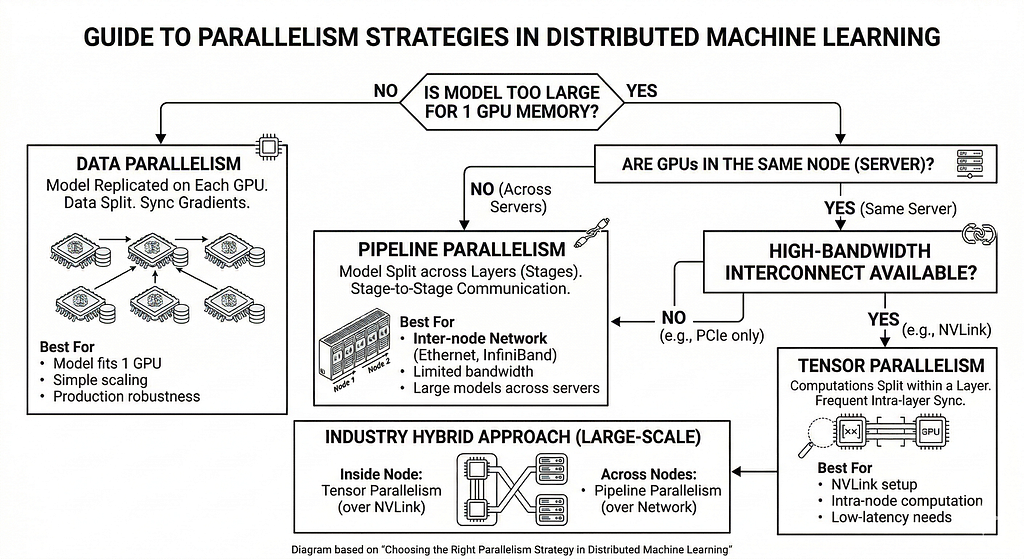
One of the most common points of confusion in distributed machine learning is deciding between tensor parallelism, pipeline parallelism, and data parallelism, especially when working with multiple GPUs across different hardware setups.
This article provides a practical, system-oriented explanation to help you make the right decision based on your infrastructure rather than assumptions.
Understanding the Core Difference
Tensor Parallelism splits computation within a layer. This requires frequent synchronization between GPUs, typically at every forward and backward pass.
Pipeline Parallelism splits the model across layers. Communication happens only at the boundaries between stages, which significantly reduces synchronization frequency.
This distinction is not merely conceptual. It directly depends on how fast your GPUs can communicate with each other.
Case 1: Multiple GPUs in the Same Server
If your GPUs are connected with NVLink, tensor parallelism is generally the preferred choice. NVLink provides very high bandwidth, which makes the frequent communication required by tensor parallelism efficient and scalable.
However, if your setup relies only on PCIe, the situation changes. PCIe offers significantly lower bandwidth compared to NVLink. In this case, tensor parallelism becomes communication-bound, where GPUs spend more time synchronizing than computing.
Pipeline parallelism is better suited for PCIe-based systems because it minimizes communication by only passing activations between layers.
A key takeaway here is that being on the same machine does not automatically mean tensor parallelism is optimal. The interconnect determines the strategy.
Case 2: Multiple Servers with GPUs over a Network
When GPUs are distributed across multiple servers, communication happens over a network such as Ethernet or InfiniBand. Compared to NVLink, these interconnects have higher latency and lower effective bandwidth.
In such environments, tensor parallelism becomes inefficient due to its heavy communication requirements.
Pipeline parallelism is more suitable because it reduces synchronization overhead and tolerates higher latency. It relies on stage-wise communication rather than frequent global synchronization.
Industry Practice
In real-world large-scale systems, a hybrid approach is commonly used:
- Tensor parallelism is applied within a node where high-speed interconnects like NVLink are available
- Pipeline parallelism is applied across nodes where communication is slower
This combination allows systems to balance computation and communication efficiently.
Where Data Parallelism Fits
Data parallelism operates differently from both tensor and pipeline parallelism.
In data parallelism, the entire model is replicated across all GPUs. Each GPU processes a different subset of data, and gradients are synchronized after each training step.
This approach is simple, robust, and widely used in production systems.
Data parallelism works well when the model fits within a single GPU and when straightforward scaling is desired. However, it becomes insufficient when the model size exceeds the memory capacity of a single device.
When to Use Each Approach
Use tensor parallelism when:
- GPUs are within the same node
- High-bandwidth interconnects such as NVLink are available
- Low-latency intra-layer computation is required
Use pipeline parallelism when:
- GPUs are connected via PCIe or across multiple nodes
- Communication bandwidth is limited
- The model is too large to fit into a single GPU
Use data parallelism when:
- The model fits into a single GPU
- You want simple and scalable training
A Common Misconception
A frequent assumption is that adding more forms of parallelism will always improve performance. In practice, this is not true.
If communication becomes a bottleneck, increasing the number of GPUs can lead to lower overall efficiency because devices spend more time waiting than computing.
Final Perspective
Distributed machine learning is fundamentally a balance between computation and communication.
The effectiveness of any parallelism strategy depends less on the number of GPUs and more on how efficiently those GPUs can exchange information.
Understanding this principle simplifies many architectural decisions and helps avoid costly inefficiencies in real-world systems.
Originally published on Medium.
Read it there